
Uber Shows What a Company with Digital Employees Will Look Like
A closer look at Uber’s Software Factory and why enterprise AI is moving from isolated chats to a managed digital team.

Key takeaways
- Uber’s experience shows a shift from isolated AI tools to managed agents that perform specific engineering workflows with human review and escalation.
- Agent value should be measured by process outcomes and quality, not by request volume, token usage, or the number of agents created.
- Laplace applies the same principle to business workflows: a digital employee needs a role, working context, tools, boundaries, and a verifiable outcome.
Table of contents
What Uber published
In August 2026, Uber explained how it manages AI use across software development at scale. More than 70% of pull requests are attributed to local or cloud agents, employees have built more than 3,600 agent skills, and those skills run more than 30,000 times per day.
The architectural conclusion matters more than the headline numbers. Uber is moving from interactive sessions initiated by engineers toward managed agents. These agents review code, help repair CI failures, validate changes visually, triage alerts, and maintain code, while people retain control through reviews and escalations.
7×
growth in active users
from February to August 2026
9.4×
growth in agentic requests
from February to August 2026
−34%
cost per 1,000 requests
from peak with the model held constant
−52%
cost per session
from the June peak with the model held constant
From an AI chat to a managed digital employee
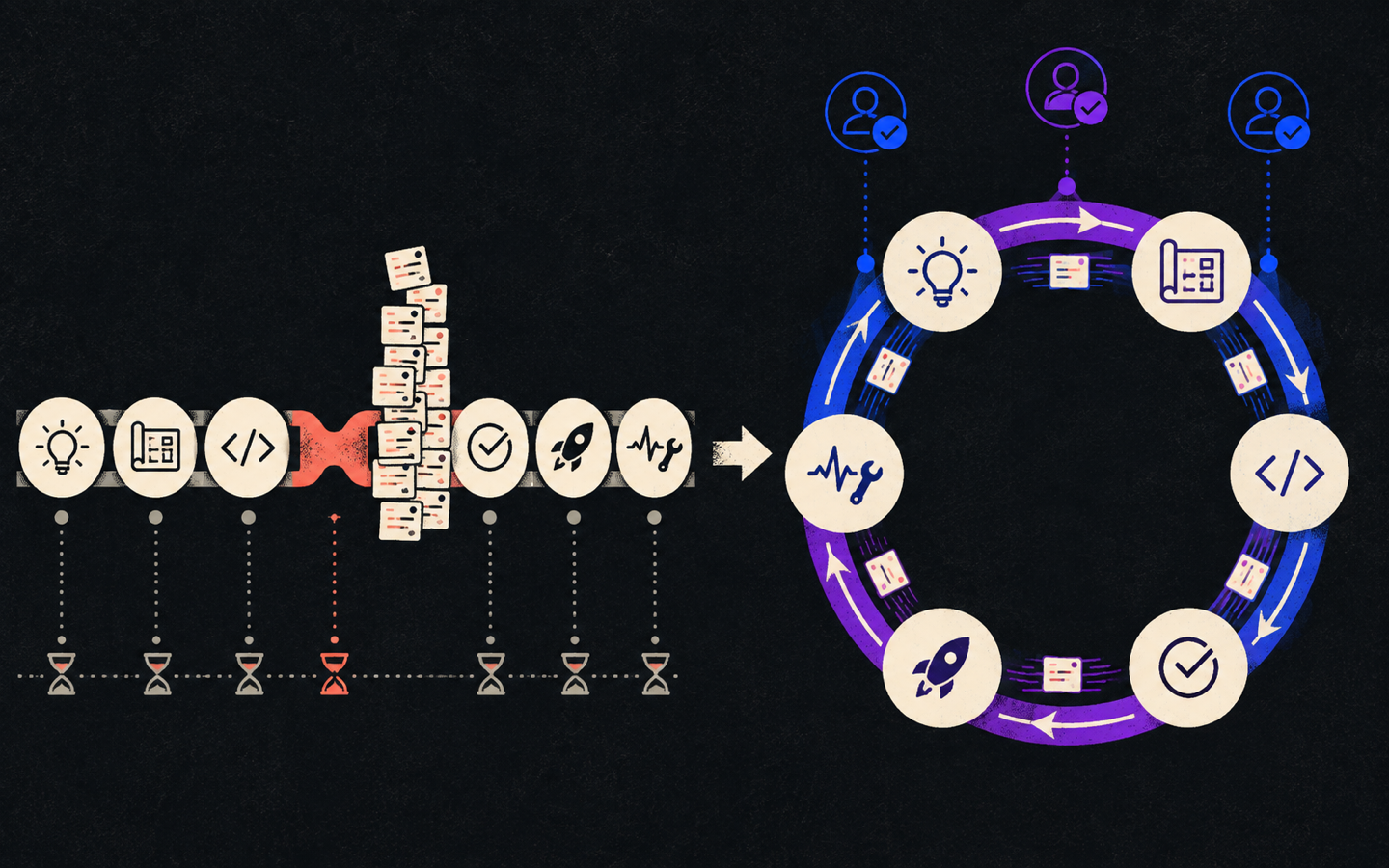
A typical AI chat responds to an individual request. The user gathers the material, frames the task, transfers the answer into a work system, and repeats the sequence next time. The tool can make a person faster without changing the complete workflow.
A managed agent works differently. It has a bounded role, a clear expected outcome, approved tools, working context, and rules for involving a person. It can run on an event or schedule and perform the same process consistently.
- The role defines which part of the process the agent owns.
- Tools determine which sources the agent can read and which actions it can perform.
- Context connects the request with current tasks, documents, changes, and decisions.
- Boundaries define permissions and situations that require human approval.
- An outcome metric shows whether the agent improves the process.
At Laplace, we call this process participant a digital employee. It is not a simulated profession or an attempt to remove people from work. It is a specialized AI agent assigned a limited, recurring part of a workflow: compiling project status, checking task quality, preparing context for a customer request, or finding discrepancies between requirements and implementation.
Turn this workflow into a managed AI agent
Build an agent with the right instructions, context, tools, and approval boundaries.
Measure AI value, not AI activity
Uber decomposes AI session spend across users, sessions, turns, requests, tokens, and token price. For managed agents, however, it uses a more meaningful layer of metrics: the cost of a completed outcome together with a quality signal.
- For code review: cost per review, precision, recall, and noise.
- For incident work: cost per triaged alert and time to recovery.
- For code changes: cost per merged pull request and revert rate.
The same principle applies to business workflows. For a digital project coordinator, the time required to produce an accurate summary and the number of blockers found matter more than message count. For a support agent, useful metrics include time to a ready answer, source coverage, and the amount of specialist editing. For a documentation assistant, they include confirmed discrepancies and accepted updates.
Agent quality depends on context quality
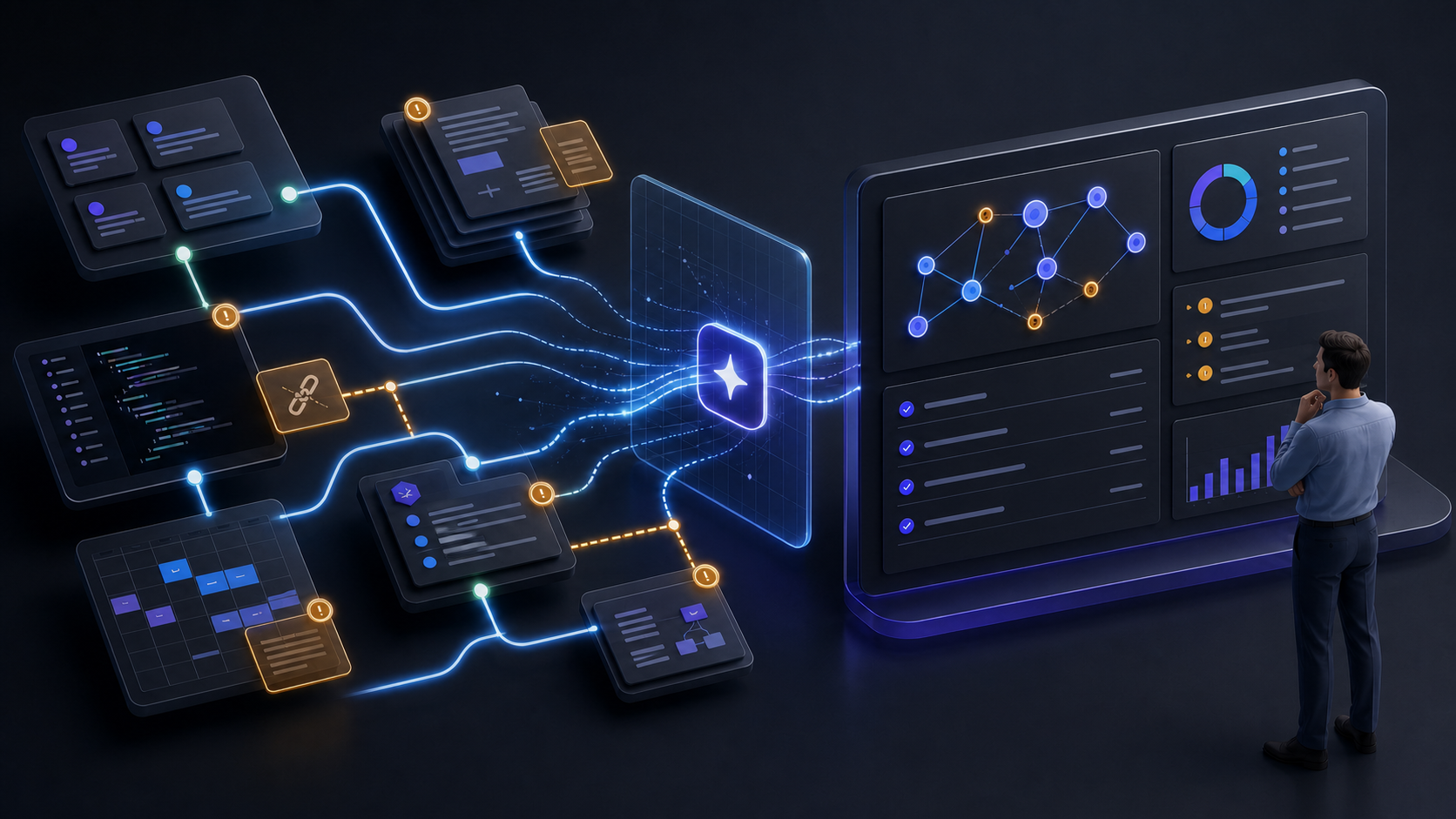
In a large organization, an agent may spend more time finding the right information than producing the result. A task can live in Jira, a decision in Confluence, its implementation in GitHub, and a critical exception in discussion history. If the relationships are unclear, AI searches more sources, consumes more tokens, and can still reach the wrong conclusion.
Uber illustrates this with one comparison. An agent with access to its internal AI Context Graph located the relevant dataset and answered correctly in 38 seconds. Without the graph, an agent spent more than 20 minutes, encountered errors, and reached the wrong conclusion. This is one Uber experiment rather than a universal speedup estimate, but it shows the value of prepared company context.
In the current Laplace product, digital employees receive context through connected work systems and documents within the permissions of a specific workspace. A unified Knowledge Graph that links tasks, documents, changes, decisions, and participants is on the product backlog. We see it as a potential future layer for a more coordinated digital team, but it is not currently an available Laplace feature.
Companies can improve the foundation before that architecture exists. If tasks are disconnected from requirements, decisions are undocumented, or documents are stale, an agent inherits those gaps. Laplace Context Audit helps identify this Context Debt and find a process that is ready for AI adoption.
One “best” AI for every task is a weak strategy
Uber selects models for specific workloads by comparing cost per completed task, quality, and reliability. A primary model can plan and evaluate work while more economical models perform well-defined subtasks. This lowers cost without automatically lowering quality.
The same specialization applies at the business level. An agent preparing a weekly status does not need the same instructions, tools, and autonomy as one analyzing an incident or reviewing a contract. A digital team should consist of roles designed around processes, rather than copies of one universal chatbot.
What Uber’s results mean for other companies
From February to August 2026, weekly active users across Uber’s agentic offerings grew sevenfold and weekly agentic requests grew 9.4 times. Holding one model fixed, cost per 1,000 requests fell about 34% from its peak, while cost per session fell 52% from its June peak. Uber notes that individual results depend on the codebase, team size, and agent workflows.
Copying the percentages would be meaningless. The useful part to copy is the method: select real work, build a benchmark from its examples, measure outcome quality and cost, and then improve model routing, context, tools, and instructions.
- Begin with one recurring process with a clear owner.
- Record a baseline for time, quality, errors, and manual context handoffs.
- Identify the required sources and repair critical data gaps.
- Bound the agent’s role and actions, with human review or approval.
- Measure the quality and cost of a completed outcome.
- Expand the digital team only after validating the pilot.
How Laplace extends this approach
Laplace brings the principle of managed agents from specialized technical use cases into everyday company workflows. An organization can create digital employees with different roles and skills, connect approved work tools, and run recurring tasks on a schedule.
The path begins with process analysis, not mass agent creation. A company needs to understand where context is lost, which actions repeat, what outcome can be verified, and where a person must remain involved. A limited scenario then becomes a measurable pilot, and validated roles can grow into a digital team.
Frequently asked questions about AI agents and Uber’s approach
- What does Uber mean by a Software Factory?
- It is a system of AI tools and managed agents across software development, including code generation and review, CI repair, incident work, and maintenance. Uber manages models, context, tools, cost, and outcome quality through a shared platform.
- How is a managed AI agent different from a chatbot?
- A chatbot usually responds to an individual user request. A managed agent has a defined role, tools, context sources, boundaries, and an outcome criterion; it can also perform a recurring process on a schedule with human oversight.
- Which AI agents are a good fit for business?
- A strong first use case repeats regularly, uses several work sources, has a verifiable outcome, and allows human control. Examples include project summaries, task quality checks, customer response preparation, and documentation discrepancy detection.
- Does Laplace have a Knowledge Graph?
- Not yet. Laplace digital employees work with connected systems and documents within the workspace available to them. A unified Knowledge Graph is on the backlog as a future direction for the shared context foundation of a digital team.
- How should a digital employee be measured?
- The metric should reflect the outcome of a specific process: time spent, completeness, accuracy, accepted recommendations, errors, or cost per completed task. Message count and agent count do not show business value on their own.